
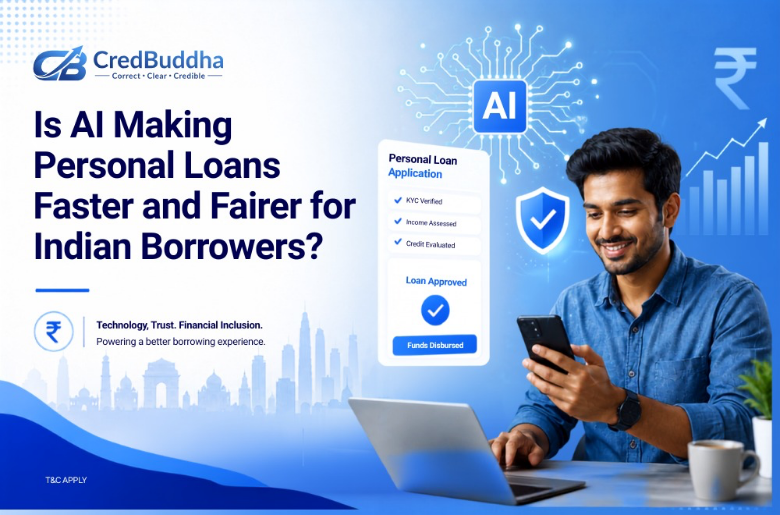
AI in personal loans is changing how lenders assess applications with AI loan approval, AI personal loan approval, AI credit assessment and AI loan processing improving speed and accuracy across digital lending India. This article explores how artificial intelligence in lending, AI loan eligibility, automated loan approval, AI in banking, personal loan technology and fintech personal loans are helping deliver instant personal loan approval with greater transparency and efficiency.
Understanding AI in Personal Lending
AI in personal lending uses machine learning, predictive analytics and automation to assess borrower creditworthiness and support loan decisions with limited human intervention. Unlike traditional checks based mainly on CIBIL scores, AI credit assessment can analyse bank transactions, repayment history and income patterns together, enabling faster AI loan processing and more informed decisions.
Digital lending systems typically combine financial data from credit bureaus, GST records, UPI transactions and the RBI-enabled Account Aggregator framework. While automated processes manage loan disbursement and document verification, machine learning models analyze this data. Because RBI regulations demand human review to maintain accountability, AI-assisted lending is still more common in India than fully automated decision-making.
The Account Aggregator concept minimizes dependence on physical documents and facilitates faster AI loan eligibility evaluation by enabling borrowers to communicate financial information digitally with lenders with explicit agreement. The RBI’s Unified Lending Interface connects banks and NBFCs with common data services, strengthening automated loan approval systems and personal loan technology across digital lending India.
How AI Transforms Personal Loan Approvals
Traditional personal loan approval typically takes two to seven working days due to manual verification of identity, address and income documents. AI in personal loans dramatically accelerates this process through multiple parallel technologies. OCR automatically extracts information from identity and income documents, while automated KYC verifies identity through facial recognition and liveness checks. Credit bureau data is retrieved instantly and Account Aggregator-based bank statement analysis allows financial information to be reviewed digitally. For straightforward applications, this can reduce decision times from several days to minutes.
Beyond speed, AI in personal loans improves fairness by applying consistent evaluation criteria. AI credit assessment reduces reliance on individual judgment and can use alternative data – including UPI transactions, GST filings and utility payments – to assess borrowers with limited or no formal credit history. This significantly improves access for thin-file and first-time borrowers, gig workers, freelancers and MSME borrowers who may be creditworthy but lack sufficient traditional credit history.
However, artificial intelligence in lending does not automatically remove bias. If historical data contains existing gaps, AI models can reproduce them. Regular model audits and fairness checks remain essential for equitable AI loan approval. Lenders employ multiple technologies including machine learning for credit risk scoring, Natural Language Processing for data analysis, predictive analytics for repayment assessment, facial recognition and video-based customer identification for verification and robotic process automation for administrative tasks.
RBI Guidelines Shaping Responsible AI Lending
Requirements for AI-assisted lending in India are defined in the RBI’s Digital Lending Directions 2025 which officially take effect on May 8, 2025. Before a loan is approved, lenders must submit a uniform Key Fact Statement that includes interest rates, fees and annual percentage rate (APR), direct disbursement to borrower bank accounts and a cooling-off period for qualified borrowers. The framework caps First Loss Default Guarantees at 5%, requires regulated lenders to retain underwriting responsibility and mandates that Digital Lending Apps be traceable to licensed banks or NBFCs. Data access must follow consent and purpose limitations under the DPDP Act 2023. These requirements strengthen transparency, borrower protection and responsible AI loan processing.
The Future of AI in Personal Loans
AI is making personal loans faster by simplifying how applications are processed, assessed and approved. It’s also opening doors for people who were often left out before – first-time borrowers, gig workers and applicants without a long credit history now have a better shot at approval through AI-based lending.
But speed alone isn’t the full picture. Responsible AI lending also means being upfront about how eligibility is decided, getting proper consent before using someone’s data, protecting that data carefully and following RBI’s Digital Lending Guidelines. While automation can speed up the approval process, the final decision regarding a loan should still be neutral, clear and supported by human judgment where necessary.
Borrowers shouldn’t simply look for the quickest approval as digital lending continues to develop in India. Comparing lenders based on eligibility requirements, interest rates, duration of repayment and procedure transparency is important. Borrowers may make better decisions and avoid loans that don’t truly meet their needs by understanding how AI-based approval really operates.
Want to see how AI can make borrowing simpler? Compare personal loan offers from India’s top banks and NBFCs on CredBuddha. Check your eligibility in seconds, compare interest rates, calculate your EMI and go through a loan process that’s faster, smarter and a lot more transparent.
For more information, visit our website – CredBuddha.
You can also explore Personal Loans options and find a loan suited to your financial needs.
